
CGPA to Percentage Converter
Convert your CGPA into an equivalent percentage in seconds.
Enter your CGPA, pick the formula your board or university uses, and get your result. This page also explains the formulas, shows ready-made tables and links to official sources, so you can check every number.
What is a CGPA to Percentage Converter?
A CGPA (Cumulative Grade Point Average) to percentage converter is a tool that turns your CGPA into an equivalent percentage score. CGPA is a grading system that shows overall academic performance as a grade point average, usually out of 10. The most widely used rule in India comes from CBSE. It multiplies the CGPA by 9.5. CBSE calls the result an “indicative” percentage, which means it is an estimate and not your original marks.
Formula: Percentage = CGPA x 9.5
Reverse formula: CGPA = Percentage / 9.5
Formula for SGPA (GPA) Calculation
SGPA = Sum of (course credits x grade point) / Sum of course credits
Formula for CGPA Calculation
CGPA = Sum of (SGPA x semester credits) / Sum of semester credits. If every semester has equal credits, this is the same as the simple average of the SGPAs.
Example on a 10-point scale
Maths 4 credits, grade O (10). Physics 4 credits, grade A (8). English 3 credits, grade B+ (7). SGPA = (40 + 32 + 21) / 11 = 8.45.
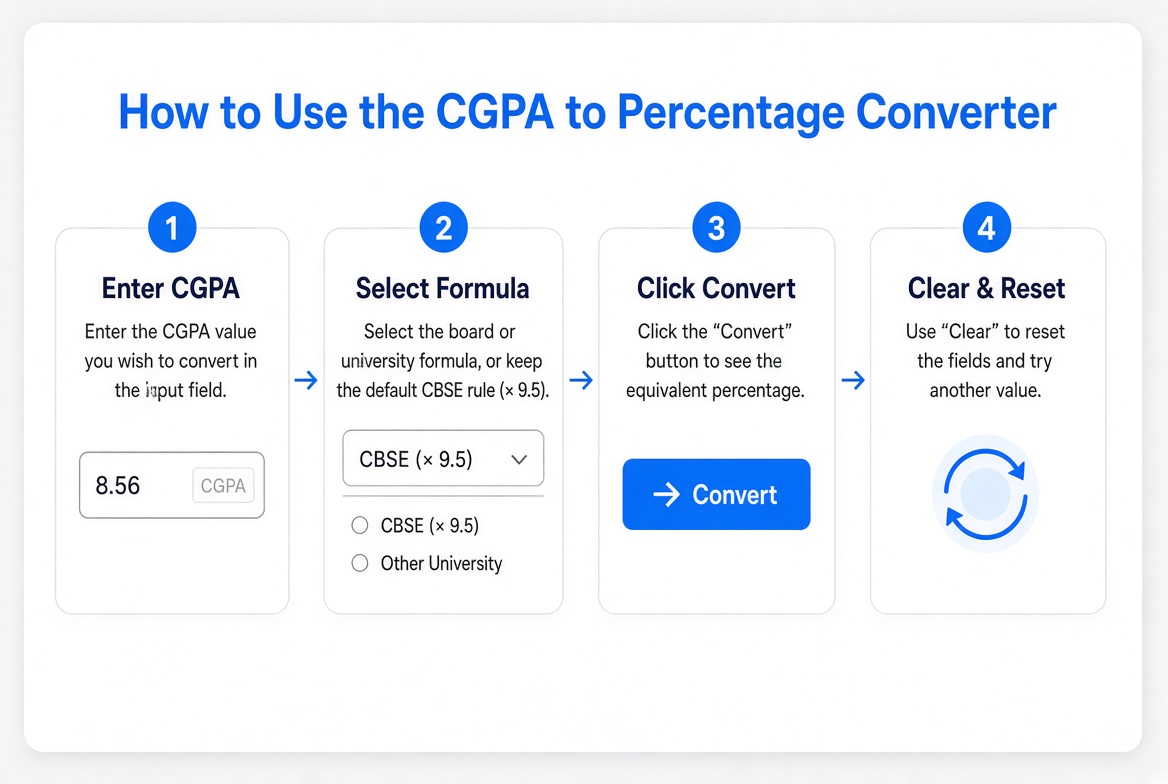
How to Convert CGPA to Percentage Online?
Students, teachers and parents can follow these steps to use the converter.
Step 1: Enter the CGPA value you wish to convert in the input field.
Step 2: Select the board or university formula, or keep the default CBSE rule (x 9.5).
Step 3: Click the “Convert” button to see the equivalent percentage.
Step 4: Use “Clear” to reset the fields and try another value.
Example of CGPA to Percentage Conversion
Input: 9 CGPA
Output: 85.5%
Working: 9 x 9.5 = 85.5
Here is one more example. A student has an 8.3 CGPA. The percentage is 8.3 x 9.5 = 78.85%.
What are the Benefits of Using the CGPA to Percentage Converter?
Many forms ask for a percentage even when your result shows a CGPA. A converter helps in these ways.
- Easy conversion: The tool does the multiplication for you and avoids small errors.
- Better understanding: You see your academic performance in a format most people know.
- Consistency: Everyone who uses the same formula gets the same answer.
- Comparability: A percentage is easier to compare with results from other institutions.
- Job applications: Many employers ask for academic performance as a percentage.
- Further studies: Some institutions set a minimum percentage for admission.
- Scholarships: Scholarship rules often state a percentage requirement.

What is CGPA and How is it Calculated?
CGPA stands for Cumulative Grade Point Average. It is the average of your grade points across a course, weighted by credits where credits are used. In school grading, each subject gets a grade, and each grade has a grade point. In college grading under the UGC credit system, each course has credits, and the weights matter. Here is how it works at college level.
- Convert each course result into a grade point.
- Multiply the grade point by the course credits.
- Add these values for the semester and divide by the total credits. This gives the SGPA.
- Combine the semester SGPAs, weighted by semester credits. This gives the CGPA.
CBSE Grade Points and Indicative Percentage
CBSE uses a 9 point grading scale. The table below shows the marks range, the grade, the grade point and the indicative percentage you get by multiplying the grade point by 9.5.
| Marks range | Grade | Grade point | Indicative percentage (GP x 9.5) |
| 91 to 100 | A1 | 10 | 95.00% |
| 81 to 90 | A2 | 9 | 85.50% |
| 71 to 80 | B1 | 8 | 76.00% |
| 61 to 70 | B2 | 7 | 66.50% |
| 51 to 60 | C1 | 6 | 57.00% |
| 41 to 50 | C2 | 5 | 47.50% |
| 33 to 40 | D | 4 | 38.00% |
| 21 to 32 | E1 | No grade point | Needs improvement to qualify |
| 20 and below | E2 | No grade point | Needs improvement to qualify |
UGC 10 Point Grading Scale for Colleges
The University Grants Commission recommends a 10 point grading system for colleges and universities. Each letter grade carries a fixed grade point.
| Letter grade | Description | Grade point |
| O | Outstanding | 10 |
| A+ | Excellent | 9 |
| A | Very Good | 8 |
| B+ | Good | 7 |
| B | Above Average | 6 |
| C | Average | 5 |
| P | Pass | 4 |
| F | Fail | 0 |
| Ab | Absent | 0 |
The UGC guidelines give the grading scale and the method to compute SGPA and CGPA. Institutions decide how marks map to letter grades, so the same marks can earn different grades in different places.
CGPA to Percentage Conversion Table (10 Point Scale)
This table covers CGPA from 10.0 to 4.0. The first result column is the CBSE rule. The other two columns show other formulas that some universities use, so you can see how much the answer changes. Use the column that matches your board or university. If you are not sure, ask your institution.
| CGPA | CBSE rule: CGPA x 9.5 | Direct rule: CGPA x 10 | Offset rule: (CGPA _ 0.75) x 10 |
| 10.0 | 95.00% | 100.0% | 92.5% |
| 9.9 | 94.05% | 99.0% | 91.5% |
| 9.8 | 93.10% | 98.0% | 90.5% |
| 9.7 | 92.15% | 97.0% | 89.5% |
| 9.6 | 91.20% | 96.0% | 88.5% |
| 9.5 | 90.25% | 95.0% | 87.5% |
| 9.4 | 89.30% | 94.0% | 86.5% |
| 9.3 | 88.35% | 93.0% | 85.5% |
| 9.2 | 87.40% | 92.0% | 84.5% |
| 9.1 | 86.45% | 91.0% | 83.5% |
| 9.0 | 85.50% | 90.0% | 82.5% |
| 8.9 | 84.55% | 89.0% | 81.5% |
| 8.8 | 83.60% | 88.0% | 80.5% |
| 8.7 | 82.65% | 87.0% | 79.5% |
| 8.6 | 81.70% | 86.0% | 78.5% |
| 8.5 | 80.75% | 85.0% | 77.5% |
| 8.4 | 79.80% | 84.0% | 76.5% |
| 8.3 | 78.85% | 83.0% | 75.5% |
| 8.2 | 77.90% | 82.0% | 74.5% |
| 8.1 | 76.95% | 81.0% | 73.5% |
| 8.0 | 76.00% | 80.0% | 72.5% |
| 7.9 | 75.05% | 79.0% | 71.5% |
| 7.8 | 74.10% | 78.0% | 70.5% |
| 7.7 | 73.15% | 77.0% | 69.5% |
| 7.6 | 72.20% | 76.0% | 68.5% |
| 7.5 | 71.25% | 75.0% | 67.5% |
| 7.4 | 70.30% | 74.0% | 66.5% |
| 7.3 | 69.35% | 73.0% | 65.5% |
| 7.2 | 68.40% | 72.0% | 64.5% |
| 7.1 | 67.45% | 71.0% | 63.5% |
| 7.0 | 66.50% | 70.0% | 62.5% |
| 6.9 | 65.55% | 69.0% | 61.5% |
| 6.8 | 64.60% | 68.0% | 60.5% |
| 6.7 | 63.65% | 67.0% | 59.5% |
| 6.6 | 62.70% | 66.0% | 58.5% |
| 6.5 | 61.75% | 65.0% | 57.5% |
| 6.4 | 60.80% | 64.0% | 56.5% |
| 6.3 | 59.85% | 63.0% | 55.5% |
| 6.2 | 58.90% | 62.0% | 54.5% |
| 6.1 | 57.95% | 61.0% | 53.5% |
| 6.0 | 57.00% | 60.0% | 52.5% |
| 5.9 | 56.05% | 59.0% | 51.5% |
| 5.8 | 55.10% | 58.0% | 50.5% |
| 5.7 | 54.15% | 57.0% | 49.5% |
| 5.6 | 53.20% | 56.0% | 48.5% |
| 5.5 | 52.25% | 55.0% | 47.5% |
| 5.4 | 51.30% | 54.0% | 46.5% |
| 5.3 | 50.35% | 53.0% | 45.5% |
| 5.2 | 49.40% | 52.0% | 44.5% |
| 5.1 | 48.45% | 51.0% | 43.5% |
| 5.0 | 47.50% | 50.0% | 42.5% |
| 4.9 | 46.55% | 49.0% | 41.5% |
| 4.8 | 45.60% | 48.0% | 40.5% |
| 4.7 | 44.65% | 47.0% | 39.5% |
| 4.6 | 43.70% | 46.0% | 38.5% |
| 4.5 | 42.75% | 45.0% | 37.5% |
| 4.4 | 41.80% | 44.0% | 36.5% |
| 4.3 | 40.85% | 43.0% | 35.5% |
| 4.2 | 39.90% | 42.0% | 34.5% |
| 4.1 | 38.95% | 41.0% | 33.5% |
| 4.0 | 38.00% | 40.0% | 32.5% |
Percentage to CGPA: minimum CGPA for common cut-offs
Many admissions and jobs state a minimum percentage. This table shows the CGPA you need under each formula.
| Minimum percentage | CGPA needed (x 9.5 rule) | CGPA needed (x 10 rule) | CGPA needed (offset rule) |
| 40% | 4.21 | 4.00 | 4.75 |
| 45% | 4.74 | 4.50 | 5.25 |
| 50% | 5.26 | 5.00 | 5.75 |
| 55% | 5.79 | 5.50 | 6.25 |
| 60% | 6.32 | 6.00 | 6.75 |
| 65% | 6.84 | 6.50 | 7.25 |
| 70% | 7.37 | 7.00 | 7.75 |
| 75% | 7.89 | 7.50 | 8.25 |
| 80% | 8.42 | 8.00 | 8.75 |
| 85% | 8.95 | 8.50 | 9.25 |
| 90% | 9.47 | 9.00 | 9.75 |
| 95% | 10.00 | 9.50 | Not reachable (above 10) |
For example, if a cut-off is 60 percent, you need a CGPA of about 6.32 under the CBSE rule, 6.00 under the direct rule and 6.75 under the offset rule.
Other grading scales (simple proportional estimate)
Some institutions grade out of 4 or out of 5. A simple proportional method divides the CGPA by the scale maximum and multiplies by 100. This is an arithmetic estimate and not an official board conversion.
4 point scale
| CGPA (out of 4) | Percentage |
| 4.00 | 100.00% |
| 3.75 | 93.75% |
| 3.50 | 87.50% |
| 3.25 | 81.25% |
| 3.00 | 75.00% |
| 2.75 | 68.75% |
| 2.50 | 62.50% |
| 2.25 | 56.25% |
| 2.00 | 50.00% |
| 1.75 | 43.75% |
| 1.50 | 37.50% |
| 1.25 | 31.25% |
| 1.00 | 25.00% |
5 point scale
| CGPA (out of 5) | Percentage |
| 5.0 | 100.0% |
| 4.5 | 90.0% |
| 4.0 | 80.0% |
| 3.5 | 70.0% |
| 3.0 | 60.0% |
| 2.5 | 50.0% |
| 2.0 | 40.0% |
Do All Boards and Universities Use the Same Formula?
No. There is no single formula for every institution. The UGC guidelines themselves say that the way marks convert to letter grades varies widely across institutions. The table below lists formulas that are commonly reported. Use it as a starting point and confirm on the official website of your board or university before you submit it anywhere.
| Board or university | Commonly reported formula | Result for 8.0 CGPA | Status | Check here |
| CBSE (CGPA grade sheets) | CGPA x 9.5 | 76% | Published by CBSE as indicative | cbse.gov.in |
| Delhi University | CGPA x 9.5 | 76% | Widely reported, confirm with DU | du.ac.in |
| Anna University | CGPA x 10 | 80% | Widely reported, confirm with the university | annauniv.edu |
| VTU | (CGPA – 0.75) x 10 for 2015 to 2018 schemes | 72.5% | Differs by scheme, confirm your scheme | vtu.ac.in |
| SPPU (Pune) | (CGPA – 0.5) x 10 | 75% | Reported, confirm with the university | unipune.ac.in |
| Mumbai University | Older rule was (CGPA x 7.1) + 11 | 67.8% | Reported as withdrawn from 1 January 2026, confirm | mu.ac.in |
Why does this matter? Take an 8.0 CGPA. It is 76% under one rule and 80% under another. Always use the formula your own institution prescribes.
How to Write CGPA on a Resume or Application Form
Give both numbers when the form allows it. Name the formula you used.
Example: CGPA 8.2 / 10 (equivalent percentage 77.9%, CGPA x 9.5)
If the form asks only for a percentage, use the rule your institution prescribes. If your institution issues a conversion certificate, attach it.
Converting CGPA for Study Abroad
Foreign universities and credential evaluators use their own methods. A quick estimate on a 4.0 scale can be done by dividing your CGPA by 10 and multiplying by 4, but it is only an estimate. Follow the instructions given by the institution you apply to. Submit official transcripts whenever they are requested.
Tips to Improve Your CGPA
- Study a little every day instead of cramming before exams.
- Ask for help early when a topic is unclear.
- Give extra time to your weakest subjects.
- Revise often and practise with past papers.
- Sleep well and keep a balance between study and rest.
Factors That Can Affect the Conversion
- Grading scale: CGPA can be out of 10, 5 or 4, and the formula changes with the scale.
- Conversion formula: Boards and universities use different multipliers and offsets.
- Institutional guidelines: Some institutions publish their own rules or issue a conversion certificate on request.
- Course weightage: Credits and course structure change how the CGPA is calculated in the first place.
What Does CBSE Say About Percentage?
CBSE issued a notice on 30 November 2023 about the calculation of percentage for Class 10 and Class 12. The Board states that it does not calculate, declare or inform the percentage of marks. It also states that no overall division, distinction or aggregate is awarded. If a percentage is needed for higher education or a job, the admitting institution or the employer may calculate it. If a student has more than five subjects, the institution or employer can decide which five count. So the 9.5 rule is a guide for CGPA grade sheets. It is not a percentage that CBSE certifies.
Difference Between CGPA, SGPA, GPA and Percentage
| Term | Full form | What it shows |
| SGPA | Semester Grade Point Average | Performance in one semester |
| CGPA | Cumulative Grade Point Average | Performance across all semesters or subjects so far |
| GPA | Grade Point Average | A general term. Often used for a single term or for the 4.0 scale used abroad |
| Percentage | Percentage of marks | Marks obtained out of the maximum marks, shown out of 100 |
CGPA measures grade points. Percentage measures marks. That is why a perfect 10 CGPA does not mean 100 percent. Under the CBSE rule it is 95%.
Example on a 4.0 scale
There is an example of how to calculate marks for 6 or 7 subjects:
- You have gotten scores 4, 4, 4, 3.8, 3.8, 2.5, 2.7 in your 7 subjects that have equal credit points (3 credits each).
- Then you multiply each grade by the credit (3).
- After that, add them all up.
- In this case, the total will be 74.4.
- Now your total credits are 21. So you have to divide 74.4 by 21 and get your CGPA 3.54.
Why People Use a CGPA Calculator?
- It gives quick results without any wait.
- This tool performs accurate conversions and reduces human errors while calculating the results.
- It is easy to use. Anyone can use this calculator without technical knowledge.
- It is an all-in-one grading system tool. It works for different grading scales like 4, 5, and 10.
- It is helpful for job applications, university admissions, and scholarships.
- It provides instant understanding and makes it easy to understand academic performance in percentage form.

CGPA Conversion for Universities & Boards
Different boards and universities use their own rules, so pick yours in the calculator above. Check each formula against your university’s official circular before you submit.
Why Trust This Converter?
Each formula is labelled Verified, Reported or Disputed. CBSE and UGC details link to official documents. Results are estimates, so confirm the final figure with your institution. Found a wrong formula? Contact us with the official circular and we will review it.

Summary
Converting CGPA to percentage is simple once you know the formula. For CBSE grade sheets, multiply by 9.5. For colleges, check the rule published by your university. Use the converter for a quick result, use the tables to plan your targets, and confirm the final figure with your institution before you submit it.
Official Sources and References
FAQ